Key Features

Training Mode
Classroom and Online

Learning Method
Lecture & Self-Study

Lecture & Self-Study
1 Month

Training Hours
3 Hours per day

Hands on Labs
Yes

Study Material
Yes

Certificate
Yes

Batches
(Mon-Thu) & (Sat-Sun)

CCIE Service Provider Course Overview
Achieving CCIE Service Provider certification proves your skills with complex service provider solutions. To earn CCIE Service Provider certification, you pass two exams: a qualifying exam that covers core service provider technologies, and a hands-on lab exam that covers service provider technologies through the entire network lifecycle, from designing and deploying to operating and optimizing.
Lab Exam Description
The Cisco CCIE Service Provider (v5.0) Lab Exam is an eight-hour, hands-on exam that requires a candidate to plan, design, implement, operate, and optimize dual stack solutions (IPv4 and IPv6) of complex service provider networks.
Candidates are expected to program and automate the network within their exam, as per exam topics below.
The following topics are general guidelines for the content likely to be included on the exam. Your knowledge, skills and abilities on these topics will be tested throughout the entire network lifecycle, unless explicitly specified otherwise within this document.
- Sr. Network engineer
- Lead Consultant
- Sr. Network administrator
- Technical Solutions Architect
There are no formal prerequisites for CCIE Service Provider Infrastructure, but you should have a thorough understanding of the exam topics before taking the exam.
CCIE candidates are recommended to have five to seven years of experience with designing, deploying, operating and optimizing Service Provider networking technologies and solutions prior to taking the exam
- Intermediate knowledge of Cisco IOS or IOS XE
- Familiarity with Cisco IOS or IOS XE and Cisco IOS XR Software configuration
- Knowledge of IPv4 and IPv6 TCP/IP networking
- Intermediate knowledge of IP routing protocols
- Understanding of MPLS technologies
- Familiarity with VPN technologies
All Cisco certifications are valid for 3 years.
Pass a qualifying exam
CCIE Service Provider Syllabus
Implementing and Administering CCIE SERVICE PROVIDER Course
- 2 month of Instructor-led classroom training
- 2 month of Virtual instructor-led group online training
- 25 days of 1-on-1 training (It saves your time as you get a personal trainer for the entire duration of the boot camp.)
Who are eligible for this course ?
- Network engineers with Core exam – Implementing and Operating Cisco Service Provider Network Core Technologies (SPCOR 350-501). This is the CCIE Service Provider Written exam which is valid as a qualifying exam for CCIE Service Provider lab exam v5.0
- Network engineer with at least five to seven years of professional experience with designing, deploying, operating and optimizing Cisco Service Provider technologies
- Network engineers need to use an expert-level problem-solving process that includes options analysis to support complex Service Provider technologies and topologies
- Network designers that design and support complex Service Provider technologies and topologies
- Students and professionals in the IT and Technologies sector who wish to enhance their knowledge and acquire an internationally recognized professional certification which can improve their job prospects
Course Outline
Upon completion of this course, candidates will have the skills and knowledge to implement:
- Describe the Service Provider network architectures, concepts, and transport technologies
- Describe the Cisco Internetwork Operating System (Cisco IOS®) software architectures, main IOS types, and their differences
- Implement Open Shortest Path First (OSPF) in the Service Provider network
- Implement Integrated Intermediate System-to-Intermediate System (IS-IS) in the Service Provider network
- Implement Border Gateway Protocol (BGP) routing in Service Provider environments
- Implement route maps and routing policy language
- Describe IPv6 transition mechanisms used in the Service Provider networks
- Implement high-availability mechanisms in Cisco IOS XR software
- Implement traffic engineering in modern Service Provider networks for optimal resource utilization
- Describe segment routing and segment routing traffic engineering concepts
- Describe the VPN technologies used in the Service Provider environment
- Configure and verify Multiprotocol Label Switching (MPLS) L2VPN in Service Provider environments
- Configure and verify MPLS L3VPN in Service Provider environments
- Implement IP multicast services
- Describe the Quality of Service (QoS) architecture and QoS benefits for SP networks
- Implement QoS in Service Provider environments
- Implement control plane security in Cisco devices
- Implement management plane security in Cisco devices
- Implement data plane security in Cisco devices
- Describe the Yet Another Next Generation (YANG) data modeling language
- Implement automation and assurance tools and protocols
- Describe the role of Cisco Network Services Orchestrator (NSO) in Service Provider environments
- Implement virtualization technologies in Service Provider environments
- Deploy Cisco IOS XR and IOS XE Basic Device Configuration
- Implement OSPF Routing
- Implement Integrated IS-IS Routing
- Implement Basic BGP Routing
- Filter BGP Prefixes Using RPL
- Implement MPLS in the Service Provider Core
- Implement Cisco MPLS Traffic Engineering (TE)
- Implement Segment Routing
- Implement Ethernet over MPLS (EoMPLS)
- Implement MPLS L3VPN
- Implement BGP Security
- Implement Remotely Triggered Black Hole (RTBH) Filtering
- Implement OSPF Special Area Types (IPv4 and IPv6)
- Implement Multiarea IS-IS
- Implement Route Redistribution
- Influence BGP Route Selection
- Implement BGP Route Reflectors
- Implement BGP Security Options
- Troubleshoot Routing Protocols
- Implement MPLS in the Service Provider Core
- Implement Cisco MPLS TE
- Configure and Verify Interior Gateway Protocol (IGP) Segment Routing
- Implement Tunnels for IPv6
- Enable and Optimize PIM-SM
- Implement PIM-SM Enhancements
- Implement Rendezvous Point Distribution
- Verify the Service Provider Backbone Operation for MPLS VPN
- Work with VRF Instances
- Troubleshoot the MPLS VPN Backbone
- Configure MP-BGP as the PE-CE Routing Protocol
- Configure and Verify PE-to-CE Routing Requirements
- Enable Shared Services VPN
- Deploy Internet Access as a VPN Service
- Troubleshoot Layer 3 MPLS VPN End-Customer Connectivity
- Implement Different EVPN Solutions
- Troubleshoot EVPN VPWS
- Implement IPv6 VPN Provider Edge Router (6VPE)
- Explore NETCONF Protocol in Cisco Devices
- Configure Cisco IOS XE Devices with RESTCONF
- Explore Cisco and OpenConfig YANG Data Models with YANG Tools
- Use ncclient and Python to Configure Cisco Devices
- Use YANG Development Kit (YDK) to Configure Cisco Devices
- Configure Model-Driven Telemetry with gRPC
- Configure Model-Driven Telemetry with gNMI
- Configure Path Disjointness with Cisco XTC
- Use Python Netmiko Library to Configure Cisco Devices
- Use Ansible to Configure Cisco Devices
- Use Cisco NSO Device Manager
- Create a Loopback Service Template
- Use Cisco NSO REST API with Postman
- Explore and Use Cisco WAE Features
What to expect in the lab exam?
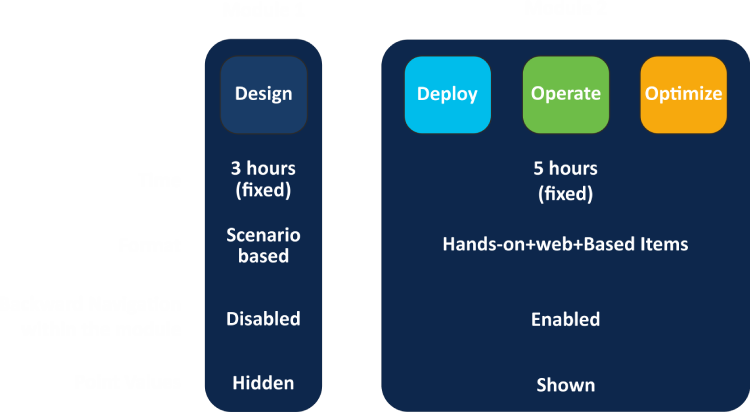
The 8 hours practical exam will assess candidate’s skills through the entire network lifecycle of designing, deploying, operating and optimizing complex network scenarios. The exam consists out of 2 modules that are fixed in time and will be delivered in a fixed sequence:
The goal of this module is to measure ability to create, analyze, validate and optimize network designs, which is the base for all deployment activities. Candidates will need to:
- Understand capabilities of different technologies, solutions and services
- Translate customer requirements into solutions
- Assess readiness to support proposed solutions
The module is scenario-based, without access to any devices. Candidates will be provided with a set of documentation required to discern before answering web-based items.
Examples of documentation include email threads, high-level design, network topology diagrams, customer requirements and restrictions, etc. Examples of web-based items include Drag-and-Drop, Multiple-Choice-Single-Answer, Multiple-Choice-Multiple-Answer, Dropdown items, etc.
During this module backward navigation will be disabled. As such, candidates will not have full visibility on all questions within this module. Points value(s) associated to each item are not displayed within this module.
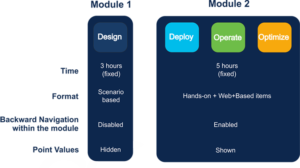
Module 2: Deploy, Operate and Optimize (5 hours)
What devices are used during practice?
The practical exam tests candidates on solutions that can be configured using the below Equipment and software versions. Candidates may see more recent software versions during their attempt but will only be tested on features that are supported in the list below.
Passing the exam requires a depth of understanding difficult to obtain without hands-on experience. Early in your preparation you should arrange access to equipment and software similar to that used on the exam.
- RR, P, and PE role: Cisco ASR 9000 Series running IOS-XR 6.5 Release
- RR and PE role: Cisco ASR 1000 series running IOS-XE 16.6.5 Release
- PE and CE role: Cisco Edge Routers running IOS-XE 16.6.5 Release
- Access and Aggregation: Cisco Access series running IOS 3.2.1S Release
- Cisco Network Service Orchestrator (NSO) running 4.7 Release
- Cisco Adaptive Security Appliance: ASA5512: 9.2
- Cisco Adaptive Security Appliance: ASA5516: 9.8
- Cisco Catalyst Switch: C3650: 16.6
- Cisco Catalyst Switch: C3850: 3.7
- Cisco Wireless Access Point: AP1852: 8.3
- Test PC: Windows 10 Enterprise
- AD/DNS: Window Server 2016
- Linux Kali: 4.17
- Cisco Anyconnect: 4.2
Do you provide Placement Assistance, post completion of the training?
We are 100% committed to offer placement assistance to our students. Industry approved Resume Templates are provided to candidates as guidance to assist them in writing their resumes. We also provide students with FAQ interview questionnaire to help them prepare for their job interviews
What is expected salary after the CCIE Service Provider Training Course?
On an average a CCIE Service Provider Certified Engineer with 5 plus years of experience gets salary in the range of INR 1,00,000 (1 Lac) per month in India.
After CCIE Service Provider training course, what is the Next Step?
Learning never stops. We always recommend CCIE Enterprise Infrastructure v1.0 (Course link) training. There is huge demand for CCIE Service Provider certified Engineers in market. These training and certification will establish your authority as an industry expert and provide you better career opportunities in the market.
Course Objectives
This course gives you the knowledge how to configure, verify, troubleshoot, and optimize next-generation, Service Provider IP network infrastructures. It provides a deep dive into Service Provider technologies including core architecture, services, networking, automation, quality of services, security, and network assurance..
This course will help you:
- Configure, verify, troubleshoot, and optimize next-generation, Service Provider IP network infrastructures
- Deepen your understanding of Service Provider technologies including core architecture, services, networking, automation, quality of services, security, and network assuran

Training Outline
- Deploy Cisco IOS XR and IOS XE Basic Device Configuration
- Implement OSPF Routing
- Implement Integrated IS-IS Routing
- Implement Basic BGP Routing
- Filter BGP Prefixes Using RPL
- Implement MPLS in the Service Provider Core
- Implement Cisco MPLS Traffic Engineering (TE)
- Implement Segment Routing
- Implement Ethernet over MPLS (EoMPLS)
- Implement MPLS L3VPN
- Implement BGP Security
- Implement Remotely Triggered Black Hole (RTBH) Filtering
Prerequisites
- Intermediate knowledge of Cisco IOS or IOS XE
- Familiarity with Cisco IOS or IOS XE and Cisco IOS XR Software configuration
- Knowledge of IPv4 and IPv6 TCP/IP networking
- Intermediate knowledge of IP routing protocols
- Understanding of MPLS technologies
- Familiarity with VPN technologies
After taking this course, you should be able to:
- Describe the Service Provider network architectures, concepts, and transport technologies
- Describe the Cisco Internetwork Operating System (Cisco IOS®) software architectures, main IOS types, and their differences
- Implement Open Shortest Path First (OSPF) in the Service Provider network
- Implement Integrated Intermediate System-to-Intermediate System (IS-IS) in the Service Provider network
- Implement Border Gateway Protocol (BGP) routing in Service Provider environments
- Implement route maps and routing policy language
- Describe IPv6 transition mechanisms used in the Service Provider networks
- Implement high-availability mechanisms in Cisco IOS XR software
- Implement traffic engineering in modern Service Provider networks for optimal resource utilization
- Describe segment routing and segment routing traffic engineering concepts
- Describe the VPN technologies used in the Service Provider environment
- Configure and verify Multiprotocol Label Switching (MPLS) L2VPN in Service Provider environments
- Configure and verify MPLS L3VPN in Service Provider environments
- Implement IP multicast services
- Describe the Quality of Service (QoS) architecture and QoS benefits for SP networks
- Implement QoS in Service Provider environments
- Implement control plane security in Cisco devices
- Implement management plane security in Cisco devices
- Implement data plane security in Cisco devices
- Describe the Yet Another Next Generation (YANG) data modeling language
- Implement automation and assurance tools and protocols
- Describe the role of Cisco Network Services Orchestrator (NSO) in Service Provider environments
- Implement virtualization technologies in Service Provider environments
Exam & Training
| Exam Name | Exam Code | Duration | Cost | Registration |
| CCIE Service Provider v5.0 | – | 8 Hours | 1600 USD | CCIE Portal |
Training Plan & Schedule
Classroom
| Date | Course | Batch | Register |
| 05 December 2022 | CCIE Service Provider | Weekdays (Mon-Fri) | Enquire now |
| 11 December 2022 | CCIE Service Provider | Weekend (Sat-Sun) | Enquire now |
| 19 December 2022 | CCIE Service Provider | Weekdays (Mon-Fri) | Enquire now |
| 25 December 2022 | CCIE Service Provider | Weekend (Sat-Sun) | Enquire now |
Virtual Classroom
| Date | Course | Batch | Register |
| 05 December 2022 | CCIE Service Provider | Weekdays (Mon-Fri) | Enquire now |
| 11 December 2022 | CCIE Service Provider | Weekend (Sat-Sun) | Enquire now |
| 19 December 2022 | CCIE Service Provider | Weekdays (Mon-Fri) | Enquire now |
| 25 December 2022 | CCIE Service Provider | Weekend (Sat-Sun) | Enquire now |
CCIE Service Provider Success Stories
I recently participated in a CCIE Training course from Mumbai Networks and I must say that I was thoroughly impressed with the quality of the program. The course was well organized and the content was comprehensive and up-to-date. The instructor was extremely knowledgeable and provided helpful insights throughout the course. I was able to understand the concepts clearly and gain valuable skills and information. I would highly recommend CCIE Training to anyone looking to take their IT career to the next level.
I recently completed the CCIE Training course and I'm incredibly impressed with the quality of the content from Mumbai Networks. The instructors did an excellent job of breaking down complex topics into easily digestible concepts. They also provided plenty of practical exercises to ensure that I was able to apply the knowledge to real-world scenarios. The course also made sure to cover all of the topics that I needed to know in order to become a CCIE certified professional. I would highly recommend this course to anyone looking to gain more technical knowledge and certification.
Recently took Mumbai Networks CCIE Training program and I am extremely pleased with the results. The instructors were knowledgeable and professional, the course material was comprehensive and well-structured, and the support staff were always available to answer any questions that I had. Throughout the program, I was able to develop my technical skills and gain a better understanding of the technology. I would highly recommend this program to anyone looking to pursue a career in networking.
Attended a CCIE Training course with Mumbai Networks and I'm so glad I did. The instructors were experienced and knowledgeable, and the course material was comprehensive and well thought out. The labs were challenging yet manageable, and I learned a great deal of valuable information throughout the course. I really appreciate the hands-on learning approach that CCIE Training offers, and I highly recommend their courses to anyone looking to gain a deeper understanding of networking technologies.
The course materials were easy to follow and the instructors were knowledgeable and experienced. The course was well laid out and the course material was comprehensive and up-to-date. I was also pleased with the personalized support I received from the instructors. I would definitely recommend Mumbai Networks CCIE Training to anyone looking for a comprehensive course to gain their certification.
Completed CCIE Training with Mumbai Networks and was very impressed with the quality of the material and instruction. The instructor was well-versed in the subject matter and was able to provide real-world examples to illustrate the concepts. The course was very comprehensive, covering topics such as networking protocols, routing, switching, and security. I was also able to take advantage of the lab environment and practice the concepts I had learned in the course. Overall, I'm very pleased with the quality of the CCIE Training course and would highly recommend it to anyone looking for a comprehensive training program.
FAQ on CCIE Service Provider
You need to pass one core exam (SPCOR 300-501) and the corresponding lab exam CCIE Service Provider v5.0 to achieve your CCIE certificate.
Yes. The same technology core exam will serve as the core exam for the CCNP and CCIE certification in any of the certification track like security, Collaboration or Data Center etc.
Once you clear the technology core exam (SPCOR 300-501), you can clear the CCIE lab exam within 3 years of passing the qualifying technology core exam. Plus if you can pass the corresponding technology concentration exam, you will get CCNP certificate too.